Tuesday, May 14, 2013

News: International Nursing Day in the Republic of Macedonia


The International Nurses Day (IND) is celebrated around the world on 12 May of each year, to mark the contributions nurses make to society. The theme for this year`s IND is Delivering Quality, Serving Communities: Nurses Leading Chronic Care.

Nurses and midwifes have vital role to play not only in the care for patients. Much more prominent will their role be in the future in preventing diseases, promoting health and community work for creating resilient communities.

The South-eastern Europe Health Network´s (SEEHN) Secretariat based in Skopje, Republic of Macedonia, has supported this year’s main celebration event in the host country of the Secretariat.

The President of the National Association Of Nurses, Technicians And Midwives, Ms. Velka Lukic in her opening speech expressed gratitude to the SEEHN Secretariat for the support and welcomed the possibility for further sub-regional cooperation and networking of the nurses in the SEE under the SEEHN auspices.


In addition,  the National Coordinator on Nursing of the Ministry of Health of Republic of Macedonia, Mrs. Nermina Fakovic, strongly supported  further development of the network of Chief Nursing Officers of the SEEHN Member States.

The SEEHN Secretariat was represented at the event by Mrs. Sanja Sazdovska, MPH, and Ministry´s of Health seconded professional to the Secretariat.

The celebration was attended by over 250 nurses and midwives from across the country, many of them being awarded this year with the Award fro Humanity.


 

Worth to follow the EU Newsletter on Public Health


For all colleagues from the SEE Health Network and our viewers beyond we recommend to follow the regular e-Newsletter of the European Commission, a site that provides entirely thrustworthy public health information and news.

Here is the link: http://ec.europa.eu/health-eu/newsletter/109/focus_newsletter_en.htm

Monday, May 13, 2013

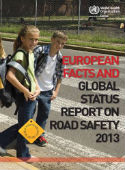
European facts and “Global status report on road safety 2013”

WHO Regional Office for Europe has just published this Policy Brief European facts and "Global status report on road safety 2013"

By Francesco Mitis and Dinesh Sethi
2013, 8 pages
ISBN 978 92 890 0297 4
Free of charge


This is the second report in a series analysing to what extent countries in the WHO European Region are implementing effective road safety measures to address the five key risk factors: drinking and driving, speeding, helmets, seat-belts and child restraints.

Though death rates are down, the report shows that 55% of the European population live in countries that do not provide the protection of comprehensive road safety laws. It also highlights the importance of issues such as vehicle safety standards, road infrastructure inspections and policies on walking and cycling. In charts, maps and tables, the brief report presents information from 51 countries, covering most of the population of the Region, and providing a baseline assessment to measure progress towards the goals of the Decade of Action for Road Safety 2011–2020.

Read the full European paper at http://www.euro.who.int/en/what-we-publish/abstracts/european-facts-and-global-status-report-on-road-safety-2013

The Global status report on road safety 2013 could be found at http://www.who.int/violence_injury_prevention/road_safety_status/2013/en/index.html

Thursday, May 9, 2013

Mapping salt reduction initiatives in the WHO European Region

Recetly WHO Regional Office for Europe published its study "Mapping salt reduction initiatives in the WHO European Region"

WHO/Europe highlights that:

"Noncommunicable diseases (NCDs) are the leading causes of mortality globally, accounting for more deaths than all other causes combined. An urgent development issue, NCDs strike hardest at the world’s low- and middle-income populations, where nearly 80% of NCD-related deaths occur. In order to reduce the growing burden of NCDs, the World Health Organization (WHO) recommends reducing salt intake in the general population as a cost-effective strategy. Measures in this direction are considered a “best-buy” approach to preventing NCDs.

Salt is a commonly used term referring specifi cally to sodium chloride (5 g salt ≈ 2 g sodium). The positive health impact of reducing an individual’s salt intake is reflected in scientific evidence of a corresponding reduction in blood pressure, among other benefits. Accordingly, WHO recommends a population salt intake level of less than 5 g per person per day for the prevention of cardiovascular diseases. Salt intake in most WHO European Region countries is far above the suggested amount. The purpose of this report is to present an up-to-date view of current salt reduction initiatives in WHO European Member States by highlighting activities related to the action points of the relevant global frameworks."

 
The full Report could be found at the following link: http://www.euro.who.int/en/what-we-do/health-topics/noncommunicable-diseases/cardiovascular-diseases/publications/2013/mapping-salt-reduction-initiatives-in-the-who-european-region

Public Health is Part of the Solution

Recently, in April 2013, WHO Regional Office for Europe held a High Level European Forum on Health Systems and the current economic crisis, organized with the kind support of the Government of Norway.

For the first time, public health, prevention of diseases and promotion of health and well-being was part of the agenda.

Obviously, strengthening sustainable investment for Public Health Services and approaches, has high potential to reduce health care costs and contribute to the economic recovery.

A full report will follow. There are, however, strong signs and call in all European countries to:
  • strengthen sustainable investment for Public Health Services and approaches to reduce health care costs and contribute to the wider economic recovery, and aim for a year on year increase in the  proportion of health sector funding directed to prevention and public health aiming to level up the European average.
  • modernise and protect effective and efficient Public Health Services and ensure sustainable financing mechanisms for example: from taxation or insurance programmes and explore innovative sources of funding.
  • a healthy workforce is a productive workforce, hence cost-saving interventions to prioritise include: mental health promotion and healthy employment approaches.
  • additional areas that have high returns on investment include: promoting green space, safer road traffic measures and active transport interventions.
  • legislative interventions on alcohol and tobacco control measures have minimal investment costs with high levels of health gain and cost savings.
  • apply a strategic approach prioritising cost-savings that maximise health outcomes;
  • ensure a life course approach is taken and inequalities are addressed in a sustainable way.
  • promote Health Impact Assessment to reduce adoption of policies that are harmful to health.
  • Build and apply knowledge, tools and raise awareness of public health and cost analysis
During the session on Public Health  related to the implementation of the European Action Plan on Strengthening Public Health Capacities and Services, a video clip has been presented.

It is already in YouTube. Watch it by following the link: http://www.youtube.com/watch?v=8KrFLetj6CQ&list=PL6BDECE22D044ED11

You kan find and use the European Action Plan for Strengthening Public Health Capacities and Services as well as many more important and useful documents on: http://www.euro.who.int/en/what-we-do/health-topics/Health-systems/public-health-services

Monday, May 6, 2013

Talking with patients and parents about HPV vaccination for girls


The WHO Regional Office for Europe has just posted an Information for health care professionals on "Talking with patients and parents about HPV vaccination for girls"
 
"Cervical cancer remains the second leading cause of death from cancer in women worldwide.
Each year, an estimated 500 000 women contract the disease and 275 000 die of it. Around 10% of these deaths occur in the WHO European Region.
HPV vaccination, in addition to cervical screening and other health promotion activities, is an effective way to prevent cervical cancer morbidity and mortality."
 
 Find the whole information on the following link:
   
http://www.euro.who.int/en/what-we-do/health-topics/noncommunicable-diseases/cancer/publications/2013/talking-with-patients-and-parents-about-hpv-vaccination-for-girls-information-for-health-care-professionals

WHO EpiBrief 1/2013

This first issue of WHO EpiBrief provides an overview of selected epidemiological characteristics of measles and rubella in the WHO European Region for 2012.
 

The full analysis in English and Russian can be read using the following link:
http://www.euro.who.int/en/what-we-do/health-topics/disease-prevention/vaccines-and-immunization/publications/who-epibrief-and-who-epidata/who-epibrief-12014